Cvc Worksheets
CVC words — consonant, vowel, consonant, like cat, pig and sun — are the first words most children learn to read by sounding out. These printable worksheets build decoding step by step: word family lists, missing-vowel practice, word building, sorting by short vowel sound, fluency lines and a quick assessment, with answer keys.
CVC Word Worksheets
Word family lists, missing-vowel, word-building, short vowel sort, fluency and real-or-nonsense worksheets for CVC words, with answer keys and an assessment sheet.
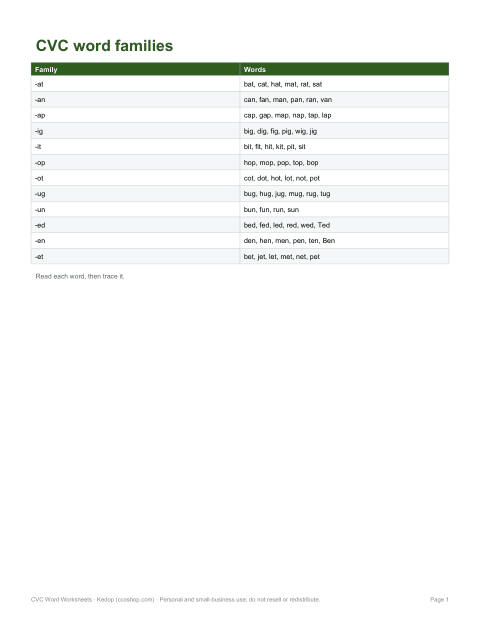
- Word family lists (PDF, DOCX)
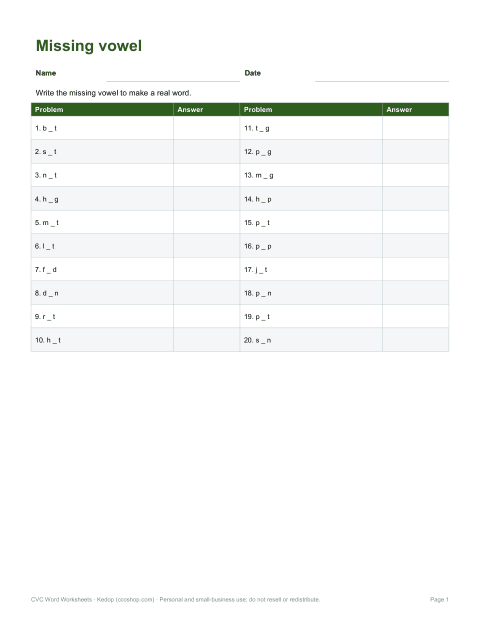
- Missing vowel (PDF, DOCX)
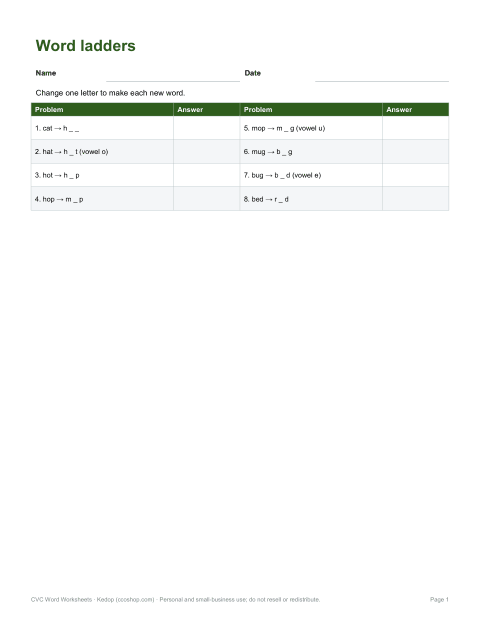
- Word building (PDF, DOCX)
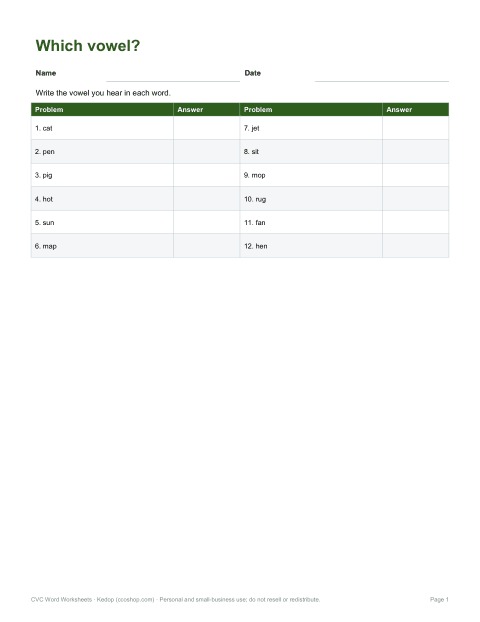
- Short vowel sort (PDF, DOCX)
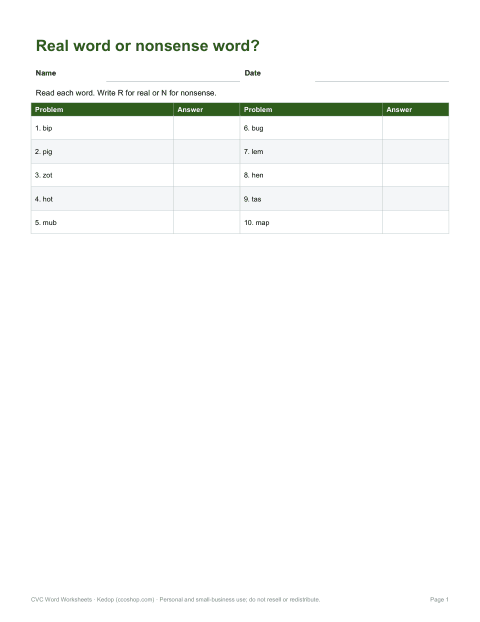
- Real or nonsense? (PDF, DOCX)
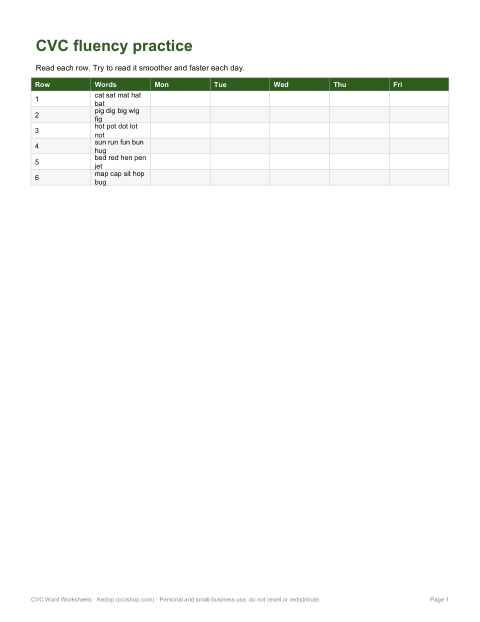
- Fluency lines (PDF, DOCX)
- Assessment sheet (PDF, DOCX, XLSX)
Formats: PDF, DOCX, XLSX. Instant download after payment (link valid 72 hours, up to 5 downloads). AI-assisted: the templates were drafted with AI help and reviewed and laid out by Kedop.
$5.00 USD, one-time
Secure card checkout by Stripe. Full refund within 7 days — see the refund policy and license.
What CVC words are
A CVC word has three letters: a consonant, a short vowel and a consonant — c-a-t, p-i-g, s-u-n. Because each letter makes its most common sound, children can read them by blending: say each sound, then push the sounds together. CVC words are usually introduced once children know most letter sounds, and mastering them gives beginning readers early success and confidence before they move on to blends, digraphs and long vowels.
Word families in the pack
| Short vowel | Word families | Example words |
|---|---|---|
| a | -at, -an, -ap | cat, fan, map |
| e | -ed, -en, -et | bed, hen, jet |
| i | -ig, -it | pig, sit |
| o | -op, -ot | mop, pot |
| u | -ug, -un | bug, sun |
Word families share an ending (the rime), so once a child can read “cat” they can read “bat”, “hat” and “mat” by changing only the first sound.
Worksheets in the pack
- Word family lists — read and trace six words from each family.
- Missing vowel — fill in a, e, i, o or u to complete each word (with key).
- Word building — change one letter at a time: cat → hat → hot → hop.
- Short vowel sort — sort mixed CVC words into columns by vowel sound.
- Fluency lines — rows of CVC words to read aloud, getting smoother each day.
- Real or nonsense? — decide whether blended words like “bip” are real, a fun way to practise decoding.
- Assessment sheet — a quick one-minute check of which families a child has mastered.
Teaching sequence
- Make sure the child knows the letter sounds used in the words.
- Model blending: point to each letter, say the sound, then sweep your finger under the word and say it smoothly.
- Start with continuous sounds (m, s, f, n) that are easy to stretch: “mmmaaat”.
- Practise one word family at a time, then mix families.
- Move to mixed vowels once each vowel sound is secure.
- Add reading CVC words in simple sentences.
Short daily practice — five to ten minutes — is more effective than long sessions.
Games to go with the worksheets
- Word ladders — change one letter to make a new word each step.
- Roll and read — roll a die and read a word from that column.
- Magnetic letters — build a word, then swap one letter.
- Silly sentences — “The cat sat on a big pig.”
- Treasure hunt — hide word cards around the room to find and read.
Who it is for
Kindergarten and first-grade teachers, reading specialists, homeschooling parents, tutors and parents supporting early readers at home. Older children who need phonics review and English language learners also benefit.
Formats
Worksheets and keys are print-ready PDFs (US Letter; they print on A4) and editable Word files, so you can swap in your own word lists.
Common difficulties and how to help
Some children say the sounds correctly but cannot blend them into a word. Try blending two sounds first (“aaat”, then “c-at”), stretching continuous sounds without stopping, and using a sliding motion under the word. Others confuse short e and short i; practise minimal pairs such as pen/pin and bet/bit, emphasising mouth shape. If a child guesses from the first letter, cover the word and reveal it one letter at a time.
Frequently asked questions
What is a CVC word?
A three-letter word with a consonant, a short vowel and a consonant, like cat or sun.
What age are CVC worksheets for?
Usually ages 4–6, in pre-K, kindergarten and first grade.
Are answer keys included?
Yes, for the missing-vowel, sorting and building pages.
Can I use my own words?
Yes, the Word versions are editable.
Was AI used to create the worksheets?
The word lists were chosen with AI assistance and the activities generated by script, then checked by Kedop.
How many CVC words should a child know?
There is no fixed number; the goal is to decode any CVC word by blending, which usually comes after practising each short vowel family.